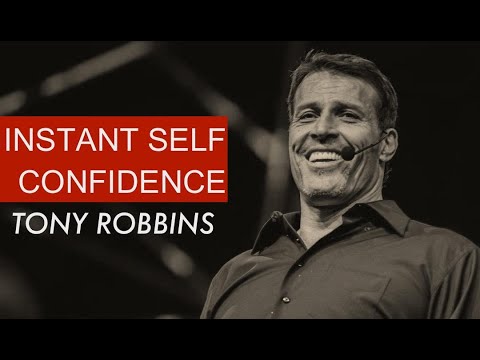
Listen to this motivational speech on instant self confidence with Tony Robbins!
Highly recommend it!

Listen to this motivational speech on instant self confidence with Tony Robbins!
Highly recommend it!
By Emmanuel SEGUI
People who have self-confidence believe in themselves and feel that they are capable of achieving what they want in life, or dealing with any situation that they may have to face. They have an aura of self-confidence and self-assurance, which is apparent to others. In contrast, there are many people who are reasonably talented, but who lack self-confidence. These people are victims of the several myths that surround self-confidence.
People who have self-confidence believe in themselves and feel that they are capable of achieving what they want in life, or dealing with any situation that they may have to face. They have an aura of self-confidence and self-assurance, which is apparent to others. People like to spend time with them; they feel comfortable and secure in their presence.
In contrast, there are many people who are reasonably talented, but who lack self-confidence. These people are victims of the several myths that surround self-confidence.
1. One of the foremost myths about self-confidence is that people are born with self-confidence. It is a quality that cannot be acquired. Nothing can be farther from truth. Self-confidence, like other skills, can be built. All that you need is right guidance and a belief in yourself.
2. There are others who blame their low self-confidence to their lack of good looks and poor upbringing. They don't realise that self-confidence has nothing to do with their looks. It is a reflection of one's confidence. The only way they can overcome this myth is by learning to believe in themselves. In fact, talent and self-confidence are not inter-related.
There are scores of talented actors and actresses who do very well in their professions but whose personal lives are torn by lack of self-confidence. It may sound contradictory, but this is how life is.
Talent can be an important component of self-confidence, but it is certainly not a substitute for self-confidence. So, don't worry about lack of talent. Harness the skills that you possess.
3. Another myth is that self-confidence is directly proportional to the recognition and praise that an individual gets in his or her life; the ones who are not so lucky wallow in self-pity. Once again, there is little doubt that recognition and praise make you feel good about yourself, and boost your self-confidence.
But you can't simply depend on the praise lavished by others. You have to work hard to earn that praise, and you can do this only if you are self-confident. The same applies to those who are not successful. They, too, can earn praise if they work hard and win people's respect.
Such people should look at children. Children believe in themselves, and this gives them the self-confidence to try to do things they have never done before, be it learning how to cycle or how to swim.
In fact, no child comes into the world knowing all the skills. But it does not take long to teach children most of the basic skills. Then, why should it be difficult for adults to learn new skills or brave new challenges?
4. Another myth is that only self-confident people can afford to take risks. This again is not true. In fact, self-confident people are more realistic about their capabilities. They know what they can do, and what they can't do. More importantly, they know how to deal with failures.
In contrast, people who lack self-confidence are afraid of failure. This fear prevents them from taking on new tasks. They constantly pine for the approval of others, and when they don't get it they end up losing their self-confidence.
What is apparent is the lack of understanding. People must realise that self-confidence is a state of mind. It is not dependent upon a person's beauty or looks. It flows from a person's self-belief, and this belief can be built.
All that a person needs to do is to debunk myths that self- confidence cannot be acquired or that self-confidence is a byproduct of exceptional knowledge, skills and luck. Once they do so, they will find it easier to acquire the same magnetic powers that self-confident people have.

Today, I am thrilled to share with you 5 of my favourite influential books on personal development. These books have had a profound impact on my life, helping me grow, learn, and make positive changes. I'm excited to introduce you to these transformative titles, and I encourage you to explore them as well. Before we dive in, I want to acknowledge that the links provided in this post are a part of the Amazon affiliate program. If you choose to purchase any of the books through these links, I may earn a small commission, which goes a long way in supporting this blog and what I do. Thank you for your continued support!

(https://amzn.to/46G9BSS)

(https://amzn.to/3ShpbQe)

Tony Robbins, a giant in the field of personal development, delivers transformative insights in "Awaken the Giant Within." Learn how to take control of your emotions, finances, relationships, and life, unleashing your inner potential.
(https://amzn.to/3Mecnq2)

Brendon Burchard's "High Performance Habits" dives deep into the habits and behaviours that can elevate your personal and professional life. Discover how to consistently excel and achieve your full potential.
(https://amzn.to/3QsYk2s)
Simon Sinek's "Start with Why" encourages you to discover your purpose and passion in life. By understanding the "why" behind your actions, you can lead with a sense of purpose and inspire those around you.
(https://amzn.to/403GCpz)
Personal development is an ongoing journey, and these books have been invaluable companions on my path to self-improvement. I encourage you to explore these titles and discover the insights and strategies they offer. By clicking on the links provided, you not only gain access to these powerful resources but also support this blog through the Amazon affiliate program. Your support is greatly appreciated, and it enables me to continue sharing valuable content with you.
Thank you for being a part of this community and for joining me on this personal development journey.
Together, we can all strive for growth and a better, more fulfilling life. Happy reading!

Self-confidence is like a superpower that allows you to conquer challenges and pursue your goals with unwavering determination. It's the key to unlocking your true potential and achieving success in various aspects of life. Many individuals struggle with self-doubt and a weak self-image, but the good news is that self-confidence can be nurtured and cultivated. In this blog post, we'll explore five effective strategies to help you build self-confidence and develop a strong self-image, drawing inspiration from personal development experts.

Know Your Strengths and Weaknesses
Self-confidence begins with self-awareness. Understanding your strengths and weaknesses is the foundation upon which you can build a positive self-image. As Tony Robbins, a renowned life coach and author, says, "To effectively communicate, we must realise that we are all different in the way we perceive the world and use this understanding as a guide to our communication with others." By recognising your unique qualities and talents, you can set a solid foundation for self-confidence.
Set Achievable Goals
Setting goals is a powerful way to boost self-confidence. Zig Ziglar, a famous motivational speaker, emphasises this when he says, "You don't have to be great to start, but you have to start to be great." To build confidence, set challenging yet achievable goals. As you accomplish smaller goals, it reinforces your belief in your abilities, as Ziglar suggests. This approach will naturally make you more self-assured and ready to tackle bigger goals.
Positive Self-Talk
The way you talk to yourself has a significant impact on your self-confidence. As Louise Hay, a pioneer in the self-help industry, once said, "You have been criticising yourself for years, and it hasn't worked. Try approving of yourself and see what happens." Replacing negative self-talk with positive affirmations is essential. Whenever self-doubt creeps in, challenge those thoughts with constructive and encouraging self-talk. Over time, positive self-talk will become a habit, just as Louise Hay recommended.
Embrace Failure as a Learning Opportunity
Failure is an integral part of personal growth and building self-confidence, as Dr. Wayne Dyer, a renowned self-help author and speaker, taught us. He said, "Failure is a judgment, an opinion. It stems from your fears, which can be eliminated by love—love for yourself, love for what you do, love for others, and love for your planet." Change your perspective on failure; view it as a valuable learning experience. Every mistake and failure teaches you something new and helps you grow. Embracing failure with a growth mindset allows you to bounce back stronger, ultimately boosting your self-confidence, as Dr. Dyer suggests.
Step Out of Your Comfort Zone
Building self-confidence often requires taking risks and stepping out of your comfort zone. Brian Tracy, a renowned self-development author and speaker, reminds us, "Move out of your comfort zone. You can only grow if you are willing to feel awkward and uncomfortable when you try something new." Challenge yourself to try new things and take on tasks that push your boundaries. By confronting your fears and insecurities, you prove to yourself that you are capable of handling difficult situations. The more you venture out of your comfort zone, the more your self-confidence will grow.
Conclusion
Self-confidence is a precious asset that can be developed and nurtured with dedication and the right strategies, as guided by these personal development experts. By knowing your strengths and weaknesses, setting achievable goals, practicing positive self-talk, embracing failure as a learning opportunity, and stepping out of your comfort zone, you can build self-confidence and cultivate a strong self-image. Remember that self-confidence is a journey, and with patience and persistence, you can unleash your inner power and achieve your dreams with unwavering belief in your abilities. So, start today, and watch your self-confidence soar to new heights.

.jpg)
What Is Emotional Resilience?
Emotional resilience is the ability to cope with, adapt to, and bounce back from difficult situations, stress, and setbacks. It's not about avoiding hardship or suppressing your emotions; rather, it's about facing adversity head-on and finding healthy ways to navigate through it. People with strong emotional resilience often exhibit the following traits:
Self-awareness: They understand their emotions and can express them in a healthy manner.
Problem-solving skills: They approach challenges with a solution-focused mindset.
Positive outlook: They maintain a hopeful perspective, even in difficult times.
Social support: They reach out to friends and loved ones for emotional support.
Now, let's explore some tips to help you build and strengthen your emotional resilience.
Tips to Improve Emotional Resilience
In conclusion, emotional resilience is a crucial skill that empowers us to thrive in the face of adversity. By developing self-awareness, cultivating a growth mindset, building a support network, and practicing stress management, you can enhance your emotional resilience and better navigate the inevitable challenges of life. Remember that building emotional resilience is an ongoing process, and with dedication and practice, you can grow stronger and more adaptable with each hurdle you overcome.
PD Tips and Favourites
Miguel Aguilera
In this episode, Brendon emphasises that resilience goes beyond coping with personal failure; it's about handling criticism and rejecting others' comparisons. Resilience, he says, is returning to your authentic self and actions. Cultivating this quality is crucial for pursuing your dreams and boosting self-esteem. Watch the video for the full insights.

Learn how to build emotional resilience to face workplace and day by day stress.
This article is not going to start with that old chestnut about interesting times, because let’s face it, we all live in interesting times. Whether it is dysfunctional governments, workplace restructures or pressure at home, all of us are in some sort of flux one way or another.
Building resilience to workplace stress is somewhat like building resilience out of the workplace but in a much more defined but un-controllable environment. In truth, unless you are the business owner you might as well face the idea - you may have the sense of a lack of control. The best thing to do is to find a way to cope.
This is where building emotional resilience really makes sense. The smarter companies are beginning to recognise this, especially as we continue the transition away from industries like manufacturing and towards a more service-based workplace environment.
What is emotional resilience? Another way of putting it is the ability to roll with the punches. It is the idea that you do not get side-tracked or thrown off course when something untoward happens at work. In the past when work was a lot more manual or systematic for people, the worst thing that happened was there was a hiccup in a mechanical process. When it happened, someone fixed it and everything started up again.
Even if you were involved in office work, the chances were you had a more defined or simplistic role - you did what you do and then went home. Those types of jobs are few and far between now. Most of them have been outsourced to places where they can be done more cheaply, without the labour implications for the bigger corporates.
Today’s workforce is now being asked to be creative, to be problem solvers and team workers, to do more with less. It is a very different job requirement and even though the recruitment ads demand “must be a team player”, who is going to respond to the question with a denial? “Not me, I can’t stand working with other people…” It’s never going to happen.
As a result, being able to survive in an ever-changing work landscape comes down to how the individual adapts to change – ultimately it is how resilient they are.
The good news is building resilience to workplace stress is something that can be taught. There are skills involved. Just like the ability to be able to weld one piece of metal to another, building emotional resilience can be learned. It takes a certain type of person to be able to teach it. They need to be adept at dealing with shifting sands underfoot and the possibility of office politics. But as they are emotionally resilient this should be a walk in the park.
Why would an organisation teach this skill? Ultimately, it is to their own advantage. An emotionally resilient employee is going to perform better than the one who runs around with their hair on fire. But luckily for everyone, this is a win-win.
We can’t control the events of our lives, but we can learn to better control our reactions to them.
Brunetti Brunetti

Are you ready to embark on a transformative journey towards personal development and success? We're excited to present to you our free gift, "The Top Tips for Self-Improvement, Motivation, and Achieving Success in Various Aspects of Life." This guide is designed to inspire and empower you to reach new heights in your life.
Within these pages, you'll not only find practical advice but also wisdom from experts in the field. Our guide is divided into six short chapters, each addressing a crucial aspect of personal growth and achievement:
Chapter 1: Setting Clear Goals for Success
In this chapter, we explore the power of setting clear and meaningful goals. You'll learn why goal-setting is the roadmap to success and discover practical strategies for defining and pursuing your objectives. We'll also reference the email on "Goal Setting: Your Roadmap to Success."
Chapter 2: Cultivating a Growth Mindset
In Chapter 2, we delve into the concept of a growth mindset. You'll understand why embracing growth and the belief in your potential to evolve are critical for personal development. This chapter relates to the email on "Embrace Growth: The Mindset Shift You Need."
Chapter 3: Overcoming Procrastination and Boosting Productivity
Procrastination can hinder your progress. In this chapter, we provide strategies to overcome it and supercharge your productivity. You'll find tips to eliminate distractions and achieve more in less time. This content aligns with the email on "Beat Procrastination and Boost Productivity."
Chapter 4: Building Resilience in Tough Times
Resilience is your secret weapon when facing life's challenges. In this chapter, we explore the importance of resilience and how to develop it. Discover how to bounce back from setbacks and navigate adversity. This chapter corresponds to the email on "Building Resilience in Tough Times."
Chapter 5: Mastering Time Management for a Fulfilling Life
Time management is crucial for success. In this chapter, we discuss effective techniques to optimise your time, increase productivity, and achieve your goals. This content aligns with the email on "Time is Your Most Valuable Asset."
Conclusion: Celebrating Your Journey to Success
We conclude with a reflection on your personal development journey. It emphasises the importance of celebrating your achievements, no matter how small, and the gratitude for the lessons learned along the way. This chapter relates to the email on "Reflect, Celebrate, and Keep Thriving."
Are you excited to start your journey towards personal growth and success? Keep an eye on your inbox for more insights, guidance, and motivational content that will complement this free gift. We're here to support you every step of the way.
To your success and personal development journey,
Miguel
You can opt-in here:
Listen to this m otivational speech on instant self confidence with Tony Robbins! Highly recommend it!
.jpg)


